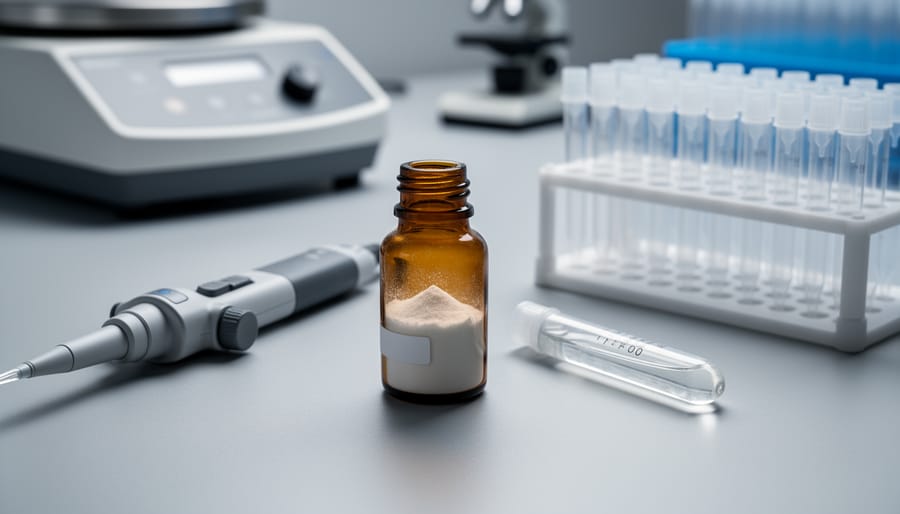
Storing and reconstituting Kylo MOTS-c in a research lab comes down to one steady habit: keep the lyophilized powder cold and dry until you’re ready, then dissolve it gently with the solvent your supplier specifies, label everything, and store the mixed solution as their documentation directs. Plan on about 15 to 20 minutes of hands-on time. The difficulty is low, but the margin for error is small, and the main prerequisite is having your supplier’s data sheet and your institution’s SOP open on the bench beside you.
Think of it the way a seamstress treats a delicate heirloom veil. Nothing about the process is flashy, but every stage depends on clean hands, the right tools and a calm pace. Canada’s wedding traditions, from Punjabi sagai ceremonies to Ukrainian rushnyk blessings, all share this respect for preparation, and a lab bench rewards the same mindset. Whether your supply is Kylo MOTS-c or another source, the principles hold: check the vial, follow the sequence, and record what you did.
This guide is written for laboratory research use only, and it defers to supplier documentation and institutional protocols at every step. It makes no medical or wellness claims. What it offers is a clear materials list, the safety stop points, an ordered method, and a way to confirm the work went right. Like careful details in a fitting room, small habits here prevent big headaches later.
Understanding MOTS-c and Why Careful Handling Matters
MOTS-c is a short peptide, a tiny chain of amino acids, that comes from the mitochondria, the small structures inside cells that help produce energy. Researchers study it mostly in metabolic research, looking at how cells handle energy and stress. Think of it as one small, specific message among many that cells pass around.
Here is why careful handling matters. Peptides are delicate, a bit like a silk veil: beautiful, but easily damaged by the wrong conditions. Warmth, moisture, light and stray microbes can all chip away at them. When storage goes wrong, a few things can happen:
– Degradation: the chain slowly breaks apart into pieces that no longer behave like the original.
– Aggregation: the molecules clump together, which can cloud the solution and change how it performs.
– Contamination: bacteria or dust sneak in and spoil the sample.
– Lost potency: the peptide is still in the vial but is less active than the label suggests, which can quietly skew results.
None of these is always obvious to the eye, which is why good habits matter more than good guesses.
One important note before we go further. This article covers laboratory research handling only. It is not medical, dietary, beauty or wellness advice, and MOTS-c is not approved as a treatment for people.
Tools and Materials to Have on Your Bench Before You Begin
Think of this as setting the table before the guests arrive. Once a vial is open, you don’t want to be hunting for a label or a clean tube, so lay everything out first and check it against your protocol.
Here’s what to gather and why:
- The lyophilized MOTS-c vial, with its certificate of analysis and lot details, so you can confirm you have the right material.
- Sterile diluent, such as bacteriostatic or sterile water, exactly as your supplier or protocol specifies.
- Sterile syringes and needles, or calibrated pipettes, to measure the diluent accurately and keep things clean.
- Alcohol swabs to sanitize the vial stopper before every puncture.
- Labels and a permanent marker so every tube carries concentration, date and initials.
- Low-protein-binding microcentrifuge tubes, because regular plastic can cling to peptides and cost you material.
- Gloves, plus eye protection and a lab coat, to protect both you and the sample.
- A clean work surface or hood, so airborne particles stay out of your solution.
- A refrigerator and a freezer with temperature logging, so you can show your material stayed where it should.
A quick word on sourcing. Not every supplier documents their work equally well, so ask for paperwork before you buy: a lot-specific certificate of analysis, clear storage instructions, and a way to reach someone if you have questions. A reputable supplier will be happy to share these. If they hesitate, that tells you something.
With your bench ready and your records handy, you can move on calmly rather than scrambling mid-process.
Safety Warnings and When to Stop
Before you open a single vial, take a breath and remember that safety comes first, much like double-checking every detail before a big day. Follow your institution’s biosafety and chemical hygiene policies, and put on gloves, eye protection and a lab coat. Handle needles and other sharps carefully, dispose of them in the proper container right away, and never recap a used needle if your lab’s rules say otherwise.
Knowing when to pause is just as important as knowing how to proceed. Set the vial aside and do not use it if you notice any of the following:
– A cracked or compromised vial seal
– A powder cake that has visibly melted or changed color
– Cloudiness or floating particles after mixing
– Missing or mismatched labels
– Diluent that is past its expiry date
– Any uncertainty about whether the vial experienced a temperature excursion during shipping
This material belongs only in in-vitro work or approved research protocols. It is not for people or animals, and it should never be self-administered. When something feels off, there is no shame in asking for help. Check your lab’s own standard operating procedures, and talk with your supervisor or safety officer before moving forward. A short conversation now can protect your work, your colleagues and your peace of mind.
Storing Lyophilized MOTS-c Before You Mix It
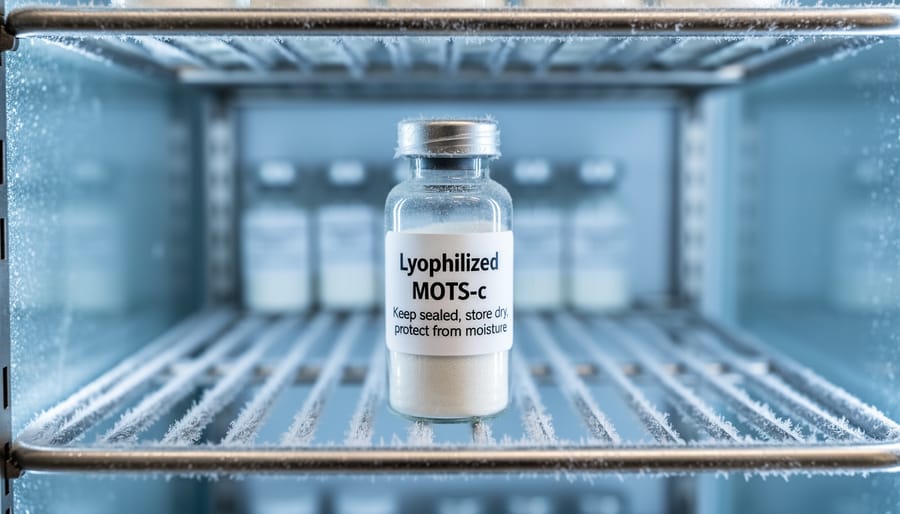
When the vial arrives, look it over before you do anything else. Check that the seal is intact, the powder (often called a “cake”) looks as expected, and the label and lot number match your paperwork. Then read the supplier’s stated storage conditions first. Their documentation, along with your lab’s SOPs, always takes precedence over general advice like this.
Think of it like caring for delicate fabric. You’d keep it away from heat, damp and bright light, and the same logic applies here. Keep the unopened vial sealed, dry and protected from light, ideally in its original packaging or a closed box.
A commonly used approach is refrigeration for short-term holding and freezer storage, such as around -20°C, for longer periods. Whichever you choose, aim for steady conditions. Repeated swings between warm and cold are one of the easiest ways to stress a freeze-dried peptide, so avoid moving the vial in and out more than necessary.
When you’re ready to use it, let the sealed vial come to room temperature before opening or piercing the stopper. Opening a cold vial invites condensation, and moisture is exactly what you want to keep away from the dry powder.
Finally, keep a simple storage log. Note the arrival date, lot number, storage location and temperature, and any time the vial left its usual spot. It takes a minute and saves real confusion later.
How to Reconstitute MOTS-c Step by Step

Reconstitution just means adding liquid back to a freeze-dried powder so it becomes a usable solution. Think of it the way you’d follow a step-by-step plan for a big event: the order matters, and rushing a single step can undo the rest. This is for laboratory research use only, and your supplier’s documentation and your lab’s SOPs always come first.
- Confirm your protocol and calculate your target concentration before touching the vial.
- Let the vial reach room temperature, then wipe the rubber stopper with an alcohol swab and let it air-dry.
- Draw up the exact volume of sterile diluent your calculation calls for, using a fresh sterile syringe or pipette tip.
- Insert the needle and let the diluent run slowly down the inside wall of the vial, never straight onto the powder.
- Set the vial down to dissolve, or swirl it very gently. Do not shake or vortex, since harsh agitation can damage a delicate peptide.
- Hold the vial up to the light and check that the solution is clear and free of particles.
- Label with the concentration, date and your initials.
- Divide the solution into single-use aliquots (small, measured portions) in low-protein-binding tubes, and store them as your protocol directs.
A quick worked example keeps the math friendly. If a vial holds 10 mg of MOTS-c and you add 2 mL of diluent, your concentration is 10 mg divided by 2 mL, or 5 mg/mL. Want 1 mg/mL instead? Divide 10 mg by 1 mg/mL and you get 10 mL of diluent. Always double-check your numbers before drawing anything up, ideally with a colleague, because a small slip here carries through to every aliquot.
Storing the Reconstituted Solution and Preventing Waste

Once MOTS-c is mixed, the clock starts ticking. Reconstituted peptide is generally far less stable than the dry powder, so treat the solution as the delicate part of your workflow. For short-term use, keep it refrigerated and shielded from light, following your supplier’s guidance or your written protocol for exactly how long and at what temperature.
If you won’t use it all soon, freeze small aliquots for longer holding where your protocol allows it. The big rule is to avoid repeated freeze-thaw cycles, because each round can chip away at the peptide’s integrity. One aliquot should equal one use, then it’s done.
A few simple habits help you prevent waste and protect your results:
– Divide the solution into small, single-use portions right away.
– Label every tube with concentration, date, initials and a use-by date.
– Keep a short log of what’s in which freezer box.
– Discard anything past its limit rather than guessing.
Plan these details early, much like budgeting for a big celebration, and nothing needs to go to waste.
Verifying Your Results and Next Steps
Once the vial is mixed, take a few quiet minutes to confirm everything went the way you planned. Think of it as the final walk-through before the guests arrive.
Start with the solution itself. Hold it up to the light: it should look clear and free of particles, cloudiness or floating specks. If it doesn’t, stop and flag it rather than pressing on.
Next, double-check your paperwork. Compare the label against your protocol, and redo the concentration math from scratch to be sure the numbers match. Then review the certificate of analysis against your own records, confirming that the lot number and details line up.
Write everything in your lab notebook: the lot number, the date, the diluent used, the final concentration and the storage conditions. Future you will be grateful.
Keep in mind that confirming identity and purity, for example through analytical testing, belongs to your lab’s quality processes, not to a visual check at the bench.
For next steps, document any deviations, even small ones, and talk them through with your supervising scientist. Before the next batch, give the protocol a fresh read and note anything worth improving.
Common Questions About Handling MOTS-c in the Lab
A few questions come up again and again at the bench. Here are short, general answers, and in every case your supplier’s documentation, your lab’s SOPs and your supervising scientist have the final word.
How long does reconstituted MOTS-c last?
It depends on the diluent, the storage temperature and the supplier’s guidance, but reconstituted peptide is generally much less stable than the dry powder. Follow the use-by limit in your documentation or protocol, and discard anything past it.
Can I refreeze it after thawing?
Repeated freeze-thaw cycles are best avoided because they can damage the peptide. That’s why small, single-use aliquots are the usual habit.
What diluent should I use?
Use whatever your supplier or protocol specifies, such as sterile or bacteriostatic water, and make sure it is in date and sterile.
What if shipping was delayed or the vial warmed up?
Record the details, check the supplier’s guidance, and talk to your supervisor or safety officer before using the material. If you’re unsure, don’t proceed.
Why is shaking discouraged?
Vigorous shaking or vortexing can foam the solution and stress the peptide. Gentle swirling or simply letting it stand is the safer approach.
Think of these as a quick checklist for the moments when you’re unsure, and when in doubt, ask before you proceed.
Handling MOTS-c well comes down to a few steady habits. Keep the lyophilized vial cold, dry and dark. Reconstitute gently with a sterile diluent, never shaking it. Divide the solution into small, clearly labeled aliquots, then verify your work and write everything down in your lab notebook. And remember, this guidance is for laboratory research use only, always within your supplier’s documentation and your institution’s SOPs.
The patience you bring to the bench is the same patience we bring to life’s big moments, where the small, careful details are what make something turn out beautifully. Thank you for stopping by, from every background and community across Canada.